Summary: To reduce rejected dental claims, integrate clinical AI evidence into the submission process by ensuring diagnostic images, periodontal findings, and clinical notes are complete and clearly support the billed procedure before submission. AI helps by enhancing image quality, aligning documentation with codes, and providing a consistent narrative, thus preventing denials and minimizing the need for appeals.
A payer asks for more detail after a scaling and root planing claim, and the front desk has to reopen a chart that seemed finished. AI cuts rejected dental claims when it turns diagnostic images, perio findings, and clinical notes into a cleaner evidence packet before submission. If it waits until the denial arrives, it is just appeal decoration. AI imaging analysis supports dental insurance submissions by making the evidence easier to see, steadier from one chart to the next, and simpler to attach to the procedure being billed. The practical goal is dental insurance claim denial prevention with AI. That means fewer missing radiographs, fewer thin narratives, and fewer claims sent out before the documentation actually matches the code.
Start with the denial reason, not the appeal letter
A rejected dental claim usually points to a missing clinical proof point, a weaker explanation, or a mismatch between the code and the record. The American Dental Association tells dentists replying to claim rejections to send a written request for reconsideration with extra documentation that gives the carrier a clearer view of why treatment was recommended. Scaling and root planing shows why the evidence standard matters. The ADA's SRP claim submission guide says dental plans list poor image quality as a common reason for denials or requests for more information, especially when carriers do not receive radiographs of diagnostic quality.
Clinical AI belongs before claim submission because a weak file costs more to fix later. A better workflow checks whether the radiograph, perio charting, and narrative support the code before the claim leaves the practice management system. Appeals stay reserved for cases where the record is already strong.
What should go into the claim file?
The claim file should connect the billed procedure to visible findings, measured findings, and a plain clinical rationale. AI does not replace the dentist's diagnosis, but it gives the team a way to catch missing support before the payer asks for it.
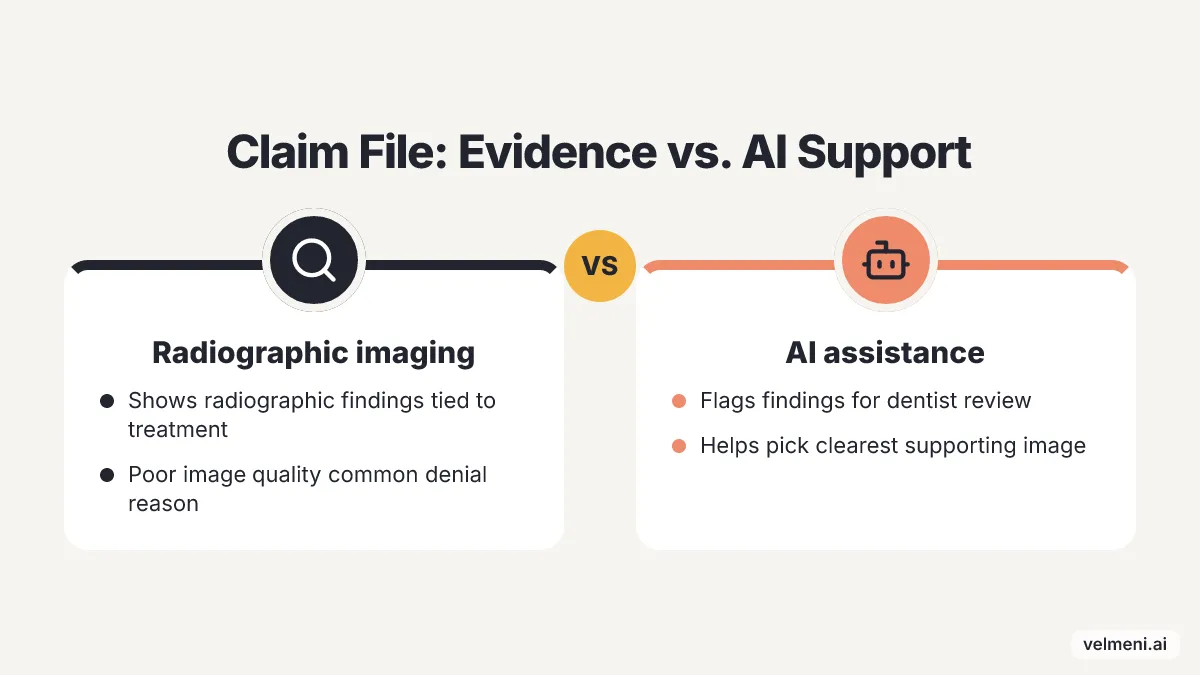
| Evidence in the record | Claim job | Where AI fits |
|---|---|---|
| Bitewing, periapical or panoramic imaging | Shows radiographic findings tied to the treatment | Flags findings for dentist review and helps the team pick the clearest supporting image |
| Periodontal charting | Supports procedures that depend on measured pocketing and bleeding | Voice-driven perio charting reduces the manual gap between the exam and the claim record |
| CBCT report or verification | Documents three-dimensional anatomy when cone beam imaging is part of care | AI-assisted review and reporting make the claim file easier to explain |
| Clinical narrative | Explains why the procedure was recommended | AI-assisted claims support helps the team align the note with the evidence already in the chart |
Springer/BMC's 2026 independent validation study on approximal caries detection found an AI system had specificity of 94.3% on bitewing radiographs. A separate Springer/BMC 2026 systematic review found radiograph-based dental caries AI models had radiograph-based specificity of 0.92. That supports AI as a consistency aid for reviewed clinical evidence, not as a payer guarantee.
VELMENI's AI platform brings AI X-ray & imaging analysis, including 2D panoramic, bitewing, and periapical views, plus 3D/CBCT AI analysis and verification, and VELMENI Voice, which is voice-driven perio charting, into the same clinical workflow. VELMENI also offers AI-assisted insurance claims support, so the evidence used in diagnosis is not cut off from the documentation used for reimbursement.
Where should AI enter the dental claims workflow?
Insurance denial prevention starts while the patient is still in the chair, because image quality and chart completeness are easiest to fix before the appointment ends. A practical workflow puts AI checks at the same points where claim evidence is created.
Use this sequence before submission:
- Capture the radiograph and confirm that the image is diagnostic enough to support the procedure.
- Review AI-flagged findings against the dentist's clinical judgment, then save the images that best support the code.
- Complete perio charting during the exam, not after the claim is queued.
- Add a narrative that explains the relationship between the finding, the diagnosis and the treatment plan.
- Check the attachment package before the claim leaves the practice, especially for SRP, implants, endodontics and CBCT-supported treatment.
The exception is a coverage problem, such as a plan exclusion or eligibility issue. Clinical AI evidence cannot make a noncovered benefit payable, so practices should verify coverage rules before asking better documentation to solve a policy denial.
Recent AI clearance activity shows the market moving toward evidence quality at capture time. In August 2026, Overjet announced FDA clearance for real-time image-quality checking, describing IRIS as the first dental imaging system cleared by the FDA to assess X-ray image quality with AI before images are used for treatment or insurance documentation.
What should a practice change before the next submission?
Pick the procedure category causing the most rejections and rebuild that claim packet first. A practice that fixes every code at once usually creates a training project, while a practice that starts with SRP, crowns or CBCT-supported cases gets a repeatable checklist faster.
CDT code drift deserves special attention before the next billing cycle. ADA News reported in March 2026 that the Code Maintenance Committee approved 67 CDT Code changes for 2027, with the new code set taking effect Jan. 1, 2027, so claim templates should be reviewed before old language creates avoidable rejections.
Dentists comparing systems should ask whether AI findings, perio charting and claim support stay in the same workflow or require staff to copy evidence between tools.
Conclusion
Choose a single high-friction claim type and audit the last batch of rejections against the evidence that should have been attached before submission. The work is not glamorous: radiograph quality, chart completeness, code fit and narrative clarity decide whether AI becomes a reimbursement tool or another disconnected software expense.
The first practical move is to build a pre-submission checklist around the procedure that loses the most time. If the clinical team can capture better images, complete the perio or CBCT documentation and attach a clearer rationale before the claim goes out, AI has a defined job and the front desk has fewer files to reopen.
