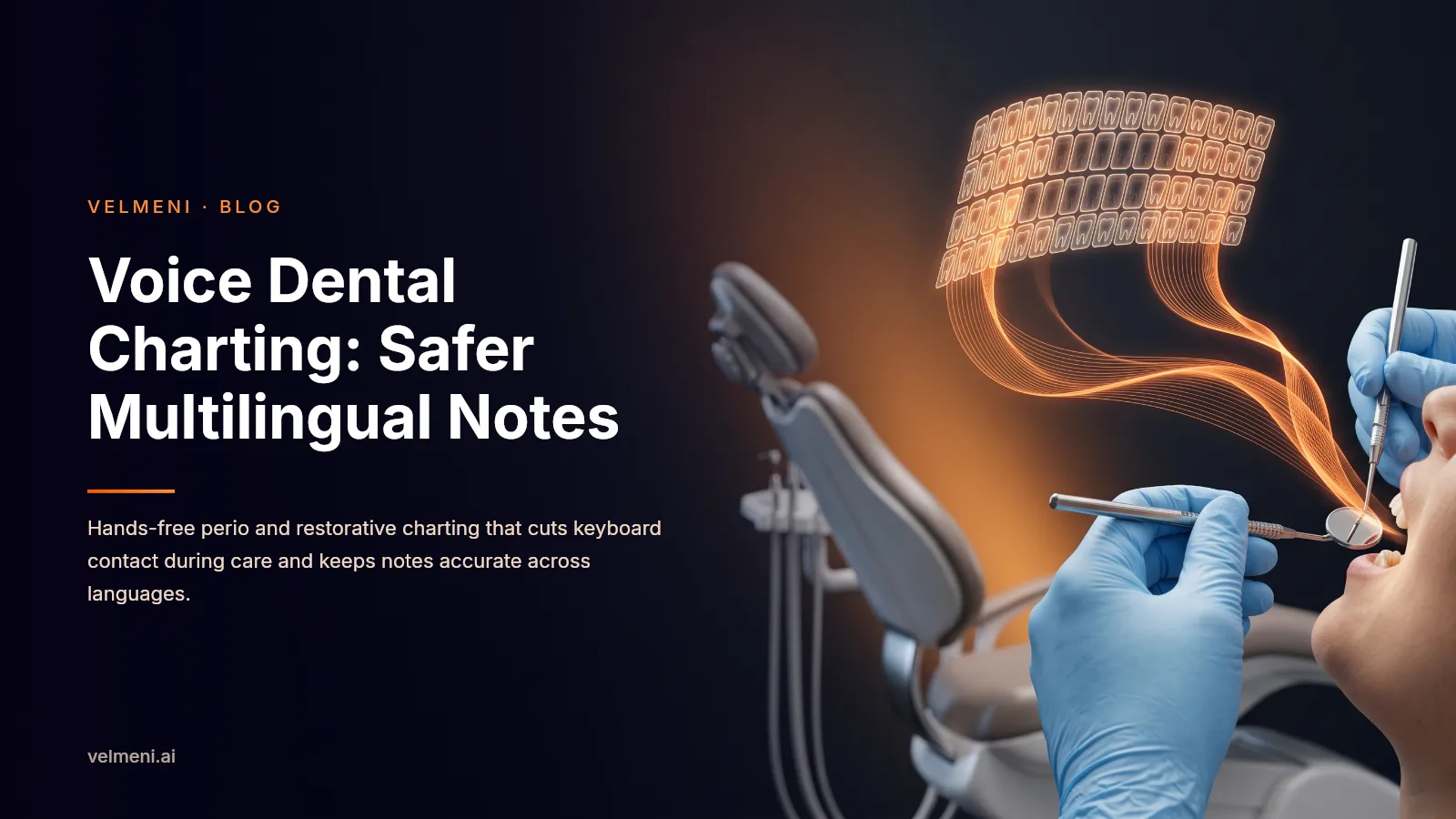
Summary: Multilingual voice transcription for dental charting workflows enhances infection control and efficiency by reducing hand contact with contaminated devices during patient care. It ensures accurate documentation across languages, supporting diagnosis, claims, and case acceptance. Effective systems capture structured clinical data in real-time, accommodating multilingual conversations and minimizing post-visit cleanup, thereby improving operatory workflows and overall practice productivity.
During a perio exam, people often say the answer is voice charting, so the hygienist no longer calls numbers to a second person. That misses the point in many practices. Speed is part of it, but so are contaminated keyboards, multilingual patient conversations, and notes that still need to support diagnosis, claims, and case acceptance after the patient leaves. Multilingual voice transcription for dental charting workflows belongs in clinical infrastructure, not in the bucket of dictation shortcuts. A dental office needs spoken entries to land in the correct structured fields, fit infection-control routines, and survive review by the dentist, biller, and patient without creating a second cleanup task later in the day.
The practical test is plain: voice charting belongs in the operatory only when it cuts hand contact during care and produces documentation strong enough for the next workflow. Perio numbers come first, but multilingual speech, imaging context, and claims evidence decide whether the system removes work or just hands it to someone else.
The keyboard is the infection-control problem, not the note
Computer contact during patient care is the weak point that hands-free clinical documentation in dental offices is meant to reduce. The CDC Summary of Infection Prevention Practices in Dental Settings from 2024 points to computer equipment as clinical contact surfaces that move microorganisms when touched during care, so the keyboard and tablet sit inside the operatory workflow, not in some harmless back room. Surface barriers stay the baseline any time computer equipment sits near patient care. The CDC dental infection-control page recommends surface barriers on hard-to-clean items such as computer equipment and changing those barriers between patients, so voice charting ought to cut touches instead of replacing the cleaning routine.
Dental keyboards have a contamination problem that has been documented for years. A Journal of Infection Prevention study from 2010 found dental clinic keyboards were contaminated with S. Aureus and other pathogens that can survive up to 10 days. That gives a practice a concrete reason to question any workflow that asks gloved staff to move back and forth between instruments and keys. Cross-contamination from everyday devices is not a theoretical concern in dental settings. A review on hidden reservoirs of pathogens reported keyboard and mobile phone contamination ranging from 4.8% in the USA to up to 30% in India. That is why the hand movement between patient, mouse, tablet, and keyboard matters during charting.
Voice charting earns its place when the hygienist can finish the clinical sequence without breaking the gloves-on workflow to touch a screen. A microphone command that creates a structured probing depth, bleeding point, or recession entry removes one repeated contact pattern. Then the next question is whether the transcription is clinically reliable enough to trust.
What should multilingual voice charting capture?
Multilingual charting needs to capture clinical meaning, not just words. A dental team serving patients who switch languages mid-sentence needs the system to preserve tooth numbers, surfaces, periodontal measurements, medication names and diagnoses while the clinician keeps working.
Speechmatics announced Oak in October 2026 as a multilingual medical speech-recognition model built for clinical transcription. The company said Oak captures multilingual medical conversations as speakers switch languages mid-sentence and keeps drug names, doses and diagnoses accurate, which points to the standard dental buyers should apply even when evaluating dental-specific systems rather than general medical transcription.
A bilingual dental visit creates two separate documentation challenges. Patient speech may move between languages during history-taking or consent, while the clinician's commands still need to map into dental structures such as probing depths, bleeding on probing, mobility, furcation involvement and restorative findings.
A voice system that only produces a paragraph creates more work for a dental office. A useful charting tool turns spoken clinical language into the perio chart, restorative chart, treatment plan or claim note without forcing a front-desk employee or hygienist to translate the dictation into structured fields later.
Accent handling and room noise matter because dental transcription happens around suction, handpieces and masks. A demo should include the practice's own operatories, the phrasing hygienists actually use, and the languages heard in the office, because a quiet vendor recording does not prove that a live hygiene column will produce clean entries.
Multilingual support should never be treated as a patient-facing courtesy alone. Accurate voice capture protects the clinical record, but the record must also connect to radiographs, 3D findings and insurance evidence if the practice wants documentation to support treatment acceptance and payment.
Where does perio charting change the operatory workflow?
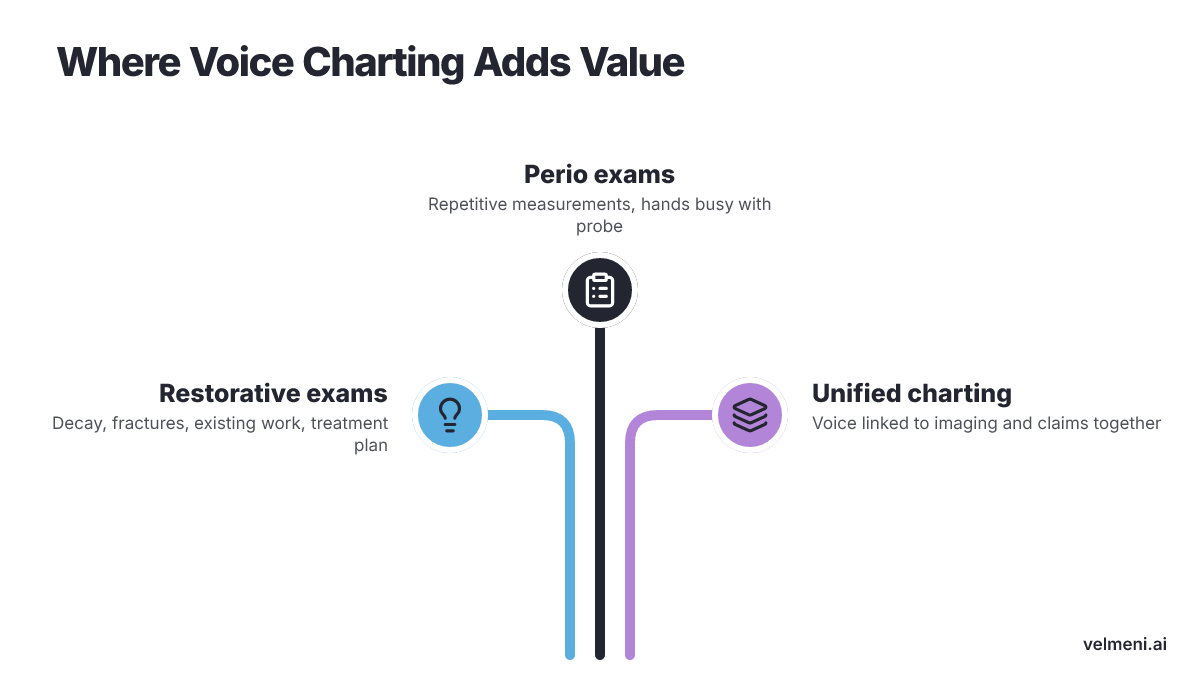
Perio charting changes the workday when the hygienist stops depending on another person or a contaminated device for every pocket depth. Voice-activated perio charting for dental hygienists is strongest in the exam sequence where numbers are repetitive, the clinician's hands are occupied and the chart needs structured entries in real time.
DentScribe introduced AI Voice Perio Charting in January 2026 as a patent-pending capability for hygienists and dentists to chart perio hands-free. Dentistry Today reported that DentScribe builds the structured perio chart in real time as clinicians speak naturally, which shows the direction of the category: voice tools are moving from dictation into live dental chart construction.
A British Dental Journal article from 2024 described voice-activated periodontal charting systems as improving infection control, ergonomics and efficiency, a combination that matters because periodontal exams are physically repetitive and documentation-heavy. The infection-control benefit is strongest when voice removes the repeated need to touch a keyboard during probing, while the ergonomic benefit comes from avoiding awkward turns toward a workstation.
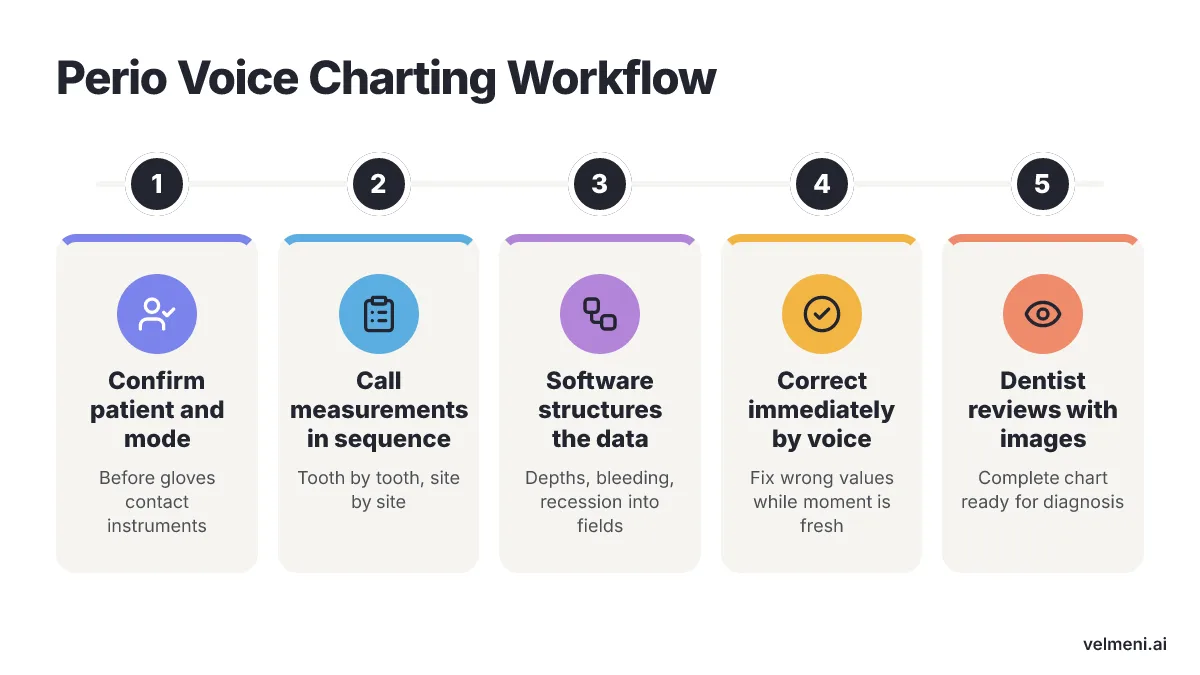
A workable perio voice workflow has a clear order:
- The hygienist confirms the patient and charting mode before gloves contact instruments.
- The hygienist calls measurements in the office's normal sequence, such as tooth by tooth and site by site.
- The software places probing depths, bleeding, suppuration, recession and mobility into structured fields.
- The clinician uses a correction phrase immediately when a value lands in the wrong site.
- The dentist reviews the completed chart with radiographs and clinical findings before diagnosis and treatment discussion.
Real-time correction is the step many practices underweight. A missed measurement discovered after the patient leaves forces staff to reconstruct the exam from memory, while an immediate voice correction keeps the note tied to the clinical moment and prepares the dentist for a faster exam.
Staffing pressure strengthens the case for voice charting, but staffing pressure should not be the only reason to buy it. Dr. Jennifer Thompson, vice chair of the ADA Council on Dental Practice, told ADA News in 2025 that dental workforce stability changed after COVID, so practices should prefer tools that reduce dependence on an extra recorder without making hygienists responsible for post-visit cleanup.
When should voice extend beyond periodontal exams?
Restorative exams deserve voice support when the dentist can turn spoken findings into chart entries while still working in the mouth, instead of waiting until the keyboard comes back into play. Perio charting is the easiest place to start because the measurements follow a pattern, but restorative exams raise the same hands-busy problem when decay, old restorations, fractures, and treatment plans have to be recorded on the spot.
Planet DDS announced AI Voice Restorative Charting in April 2026. Dentistry Today reported that the launch extends voice-driven documentation to decay and restorative findings, including existing restorations, fractures and treatment plan entries, which shows the category moving beyond hygiene-only charting and into broader clinical exams. Accuracy matters more here because the entry feeds diagnosis, treatment sequencing, and insurance paperwork. A wrong perio number is bad. A wrong surface, lesion description, or fracture note can change the treatment plan and leave the office defending a claim record later.
The strongest voice workflow ties the spoken note to evidence the dentist can point to. When restorative findings sit next to bitewings, periapicals, panoramic images, or CBCT analysis, the dentist can move from detection to patient explanation without rebuilding the story in separate systems.
VELMENI is positioned as the industry's only unified AI platform combining 2D and 3D imaging, claims and voice into one FDA-cleared dental system. In the workflow discussed here, VELMENI Voice supports voice-driven perio charting while AI X-ray & imaging analysis (2D: panoramic, bitewing, periapical), 3D/CBCT AI analysis and verification, and AI-assisted insurance claims support keep the chart from turning into a lonely note that dies in the operatory. That kind of system asks for more careful selection, because the practice has to test more than transcription. The evaluation should look at how the voice entry appears during imaging review, whether claim support draws from the same clinical evidence, and how the dentist explains findings to patients who need to see why treatment is being recommended.
A small single-operatory practice with a steady assistant and a light perio load should not buy a large voice-and-imaging platform before fixing basic barrier use, template discipline, and chart review habits. Manual charting is the cheaper answer when the documentation load stays light and the team already avoids touching shared devices during patient care.
How should a practice choose a voice charting system?
A dental practice should choose by workflow fit before it chooses by speech-recognition claims. The best demo is not a vendor presentation. It is a live hygiene or restorative sequence using the office's phrasing, languages, PPE routine, and chart review process.
The first test is infection-control fit. A buyer should ask where the microphone sits, how commands work with masks and suction, whether staff must touch a mouse to correct entries, and how the system behaves when the clinician pauses for patient conversation. That last part matters because a chairside workflow can look slick in a conference room and still fall apart once the room fills with sound, hands, and gloves.
The second test is documentation structure. A buyer should watch whether probing depths, bleeding points, recession, restorative findings, and treatment plan items land in fields the practice already uses. A polished transcript still fails if a staff member has to rebuild the chart by hand afterward. The third test is multilingual performance. A buyer should include the languages and accents heard in the office, then ask the vendor to process code-switching between patient conversation and clinician commands. Multilingual accuracy matters most when the patient interaction and the clinical record happen at the same time.
The fourth test is downstream use. A buyer should ask how the charted finding connects to imaging review, patient education, and claim documentation, because the value of voice charting shows up after the spoken entry moves into diagnosis, presentation, and payment.
What the main options are built to do
| Option | Best fit | Infection-control value | Documentation limit to test |
|---|---|---|---|
| Perio-only voice charting | Hygiene columns with repeated probing measurements | Cuts down keyboard or tablet contact during periodontal charting | Check whether corrections land on the right tooth and site during a live exam |
| Restorative voice charting | Exams that capture decay, restorations, fractures and treatment plan entries | Keeps the dentist's hands away from the keyboard through more of the clinical exam | Check whether surface, tooth and treatment-plan entries map cleanly into the chart |
| Unified voice, imaging and claims platform | Practices that want charting tied to radiographs, CBCT review and payment support | Reduces separate handoffs between operatory notes, imaging review and claim evidence | Check whether the same finding carries through diagnosis, patient explanation and claim support |
Dental practices looking at vendors should treat this breakdown as a functional map, not a product leaderboard. A perio-only application covers the bases when hygiene documentation causes the real delays. An integrated platform that bundles imaging and billing makes sense if your assistants spend half their afternoon retyping tooth numbers across radiographs, ledger entries, and claim attachments.
Recent guidance around infection control keeps this kind of software investment realistic. ADA News pointed out in September 2026 that CDC updates on respiratory-virus exposure created no new dental requirements and left baseline precautions intact for dental practices. Since the regulatory baseline has not moved, teams should judge hands-free tools by cleaner treatment rooms and faster charting, not by fear of sudden enforcement changes.
Run your trial runs in real treatment rooms instead of boardrooms. Put one hygienist and one doctor on the software for two weeks. Inspect the records every evening, and see whether anyone still reaches for the mouse during probing.
Conclusion
Hygiene rooms with back-to-back periodontal exams offer the clearest proof of concept. Probing creates constant barrier adjustments, the numbers follow a predictable rhythm, and the supervising dentist can inspect the resulting record before the patient leaves the chair.
Set up the trial with strict operational limits. Pick the phrases your clinicians will speak aloud. Include terms for non-English speakers who visit the office. Define the exact prompt that deletes a misheard depth, and check whether the exported file gives your insurance coordinator enough detail to submit a claim. Walk away from any platform that merely dumps an unformatted text transcript into the ledger, since paying your staff to re-enter those measurements defeats the point of buying software in the first place.
Frequently Asked Questions
Where can a dental office find voice-driven perio charting?
Look toward specialized dental software companies that write code for grid-based periodontal measurements, rather than speech-to-text programs built only for casual office notes.
What should hygienists ask before using voice charting every day?
Clinicians need to find out how well microphones filter out high-volume suction, how well the engine understands words through level-three masks, and what verbal trigger edits a number if a patient twitches during probing. A reliable system lets the clinician keep instruments in hand, avoid plastic keyboard wraps, and correct a six-millimeter pocket reading on the spot without restarting the whole quadrant.
Where to go next
Sources
- British Dental Journal (Nature) — "Voice-activated charting systems"
- CDC — Sterilization and Disinfection, Dental Infection Control
- CDC — Summary of Infection Prevention Practices in Dental Settings (2024)
- Journal of Infection Prevention (SAGE) — "Are computer keyboards a cross-infection risk in a dental clinic?" (2010)
- PMC — "Hidden reservoirs of pathogens in dental settings"
- Dr. Jennifer Thompson, vice chair of the ADA Council on Dental Practice
